





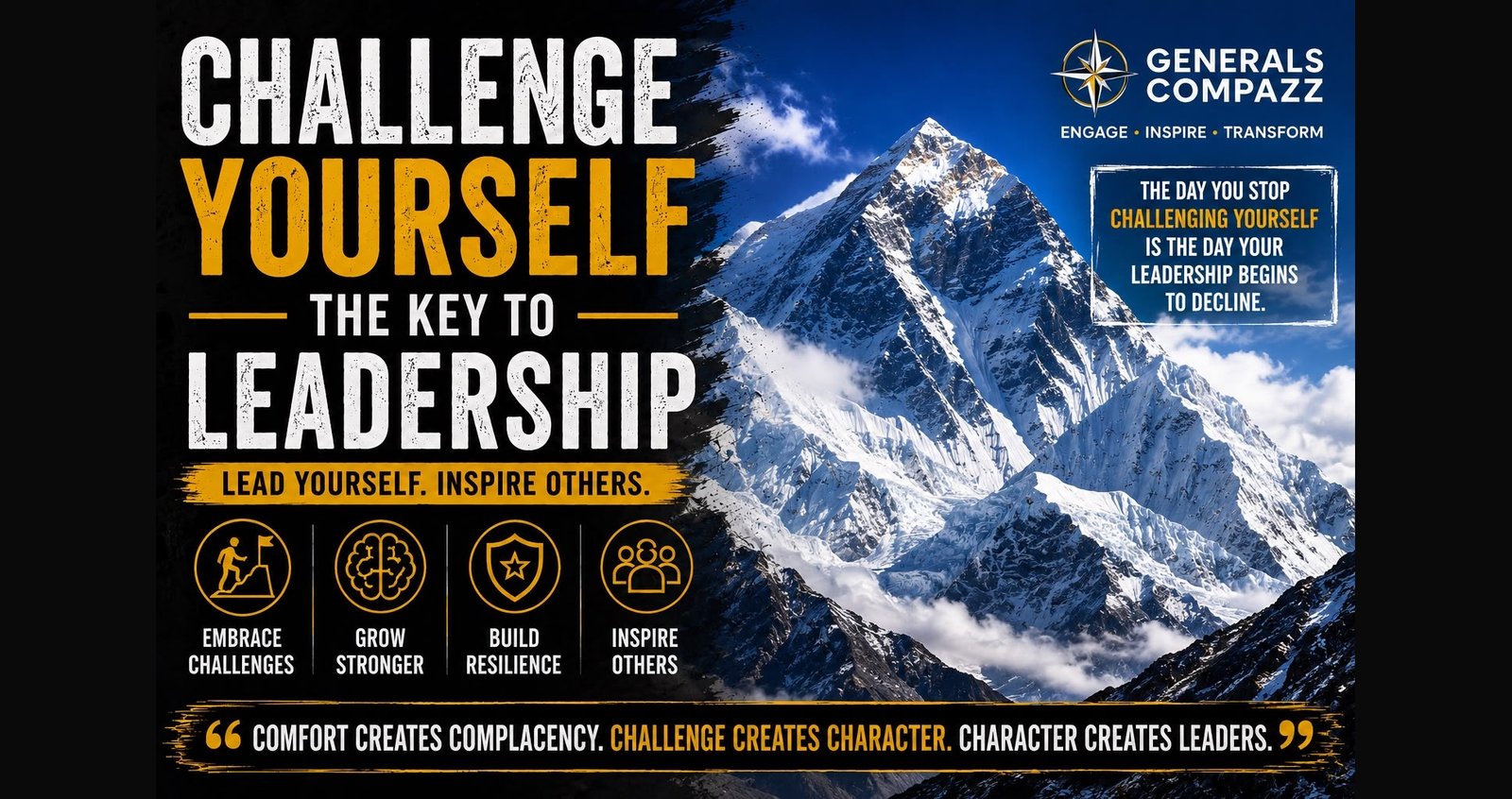
Challenge Yourself: The Key to Leadership
Leadership Begins with Leading Yourself
Leadership is often misunderstood as the ability to direct others. In reality, true leadership begins much earlier—it starts with the courage to lead yourself.
Every time you challenge yourself, you expand your capacity to lead others. History does not remember leaders because they lived comfortable lives; it remembers those who willingly chose difficult paths, accepted responsibility, and emerged stronger from adversity.
The greatest leaders intentionally step outside their comfort zones. They embrace uncertainty, accept demanding assignments, learn from setbacks, and continue growing throughout their lives. Leadership is not a destination; it is a lifelong journey of self-improvement.
Why Do Some Leaders Continue to Grow?
Have you ever wondered: Why do some people continue growing while others plateau? Why do certain leaders inspire confidence during crises? What separates ordinary managers from extraordinary leaders?
The answer is remarkably simple: they constantly challenge themselves.
The Three Zones of Growth
Every individual lives within three distinct zones:
- Comfort Zone – Safe, familiar, and predictable.
- Growth Zone – Where learning, confidence, and leadership develop.
- Panic Zone – Where pressure overwhelms learning.
Great leaders spend most of their lives in the ‘Growth Zone’. Staying comfortable may feel pleasant, but comfort rarely produces excellence. Every meaningful achievement lies just beyond, what feels easy.
Lessons from the Military
One of the greatest strengths of military leadership development is that it deliberately exposes leaders to diverse and demanding environments.
A military officer may serve in varying assignments and operations like High-altitude operations or Counter-insurgency environments or deployed in United Nations missions. They may be in command appointments or discharging staff responsibilities or serving in training institutions.
Each assignment demands new skills, fresh thinking, and rapid adaptation.
One of the enduring lessons of military life is simple:
“Never seek an easy posting. Seek the posting that makes you a better leader.”
Leadership Means Acting Despite Uncertainty
Real leadership rarely comes with complete information.
Throughout my military career, I discovered that uncertainty is not an exception—it is often the norm. Decisions often must be made when information is incomplete, time is limited, and responsibility is immense.
Leadership is not about waiting until every answer is available. It is about accepting responsibility when others hesitate.
The willingness to act decisively, while still being accountable, separates leaders from followers.
What Science Says About Challenge
Modern neuroscience confirms what great leaders have always known. Learning difficult skills builds new neural pathways, increases adaptability, strengthens emotional resilience, and improves confidence.
Growth occurs when the brain is required to solve unfamiliar problems.
In other words, discomfort is not the enemy of growth—it is the catalyst for it.
Confidence Is Earned; Not Given
Many people wait until they feel confident before acting. Successful leaders understand the opposite.
Confidence does not come before action. Confidence comes after repeatedly overcoming challenges.
Whether it is public speaking, leading a large team, learning innovative technology, starting a business, or authoring a book, every small victory strengthens belief in one’s own abilities.
Action creates confidence.
Failure Is a Leadership Classroom
Every accomplished leader has experienced failure.
- Abraham Lincoln lost numerous elections before becoming President of the United States.
- Steve Jobs was removed from the very company he founded before returning to transform Apple.
- Dr. A. P. J. Abdul Kalam experienced early setbacks before leading India’s missile programme.
Failure is not the opposite of success.
Failure is data.
Failure is feedback.
Failure is preparation for future success.
Seven Daily Habits That Build Leaders
Leadership is rarely transformed overnight. It is built through consistent daily habits.
Challenge yourself to:
- Read one new idea every day.
- Learn one new skill every month.
- Speak with someone who disagrees with you.
- Exercise consistently.
- Mentor younger colleagues.
- Seek honest feedback.
- Volunteer for difficult assignments.
Small daily challenges accumulate into extraordinary leadership over time.
Adopt the Challenge Mindset
Leadership begins with changing the conversation you have with yourself.
Replace:
- “I can’t.” with “I haven’t learnt it yet.”
- “This is difficult.” with “This is making me stronger.”
- “I hope someone solves this.” with “I will take responsibility.”
These simple shifts create powerful changes in attitude and behaviour.
Final Thoughts
The day we stop challenging ourselves is the day our leadership begins to decline.
Comfort creates complacency.
Challenge creates character.
Character creates leaders.
If you aspire to inspire others tomorrow, challenge yourself today. Every difficult decision, every setback, and every new responsibility shapes the leader within you.
Leadership is not forged in moments of comfort. It is forged in moments of challenge.
Remember
“Leadership begins where excuses end.”
“Every challenge accepted today becomes confidence tomorrow.”
“Your greatest competition is the person you were yesterday.”
As leaders, our responsibility is not merely to achieve success but to continuously become better versions of ourselves. Because when we grow, everyone we lead grows with us.
At Generals Compazz, which is a moral compass, I believe that leadership is not a position—it is a daily commitment to challenge yourself, inspire others, and leave every place stronger than you found it.
Jai Hind
Maj Gen Ranjit Singh Ghumman, SM, VSM, PhD
Motivational & Leadership Speaker | Life Coach | Nation Builder | Author | Mentor